What's at Stake
Antisemitism in New York is not background noise anymore. It is the foreground.
We do not believe the answer to a hostile climate is fear, withdrawal, or making ourselves smaller. We believe the answer is showing up. But showing up requires clarity. Jewish New Yorkers deserve an honest picture of the moment we are in, and what it demands of us.
The numbers
Antisemitism in New York is not episodic. It is sustained, disproportionate, and rising.
In 2025, the NYPD recorded that antisemitic hate crimes comprised 57% of all reported hate crimes in a city where Jews make up roughly 12% of the population. The year prior, antisemitic hate crimes comprised 51% of the total.
Source: NYPD, January 2026.
Since 2021, average monthly antisemitic hate crimes in New York have risen by more than 57%, while incidents targeting most other groups have declined.
Source: Nexus Project analysis of NYPD data.
Nearly half of Jewish adults in the New York area report feeling unsafe attending certain places or events as Jews; among them, 44% say that fear has changed their behavior.
Source: UJA-Federation of New York, 2024.
Orthodox Jewish New Yorkers—roughly 20% of the city’s Jewish population—were the targets of more than half of all anti-Jewish physical assaults in 2024. The threat is not abstract; it is visible and geographically concentrated.
Source: ADL, 2025.
What it looks like
The data is not theoretical. It is visible across daily life in New York.
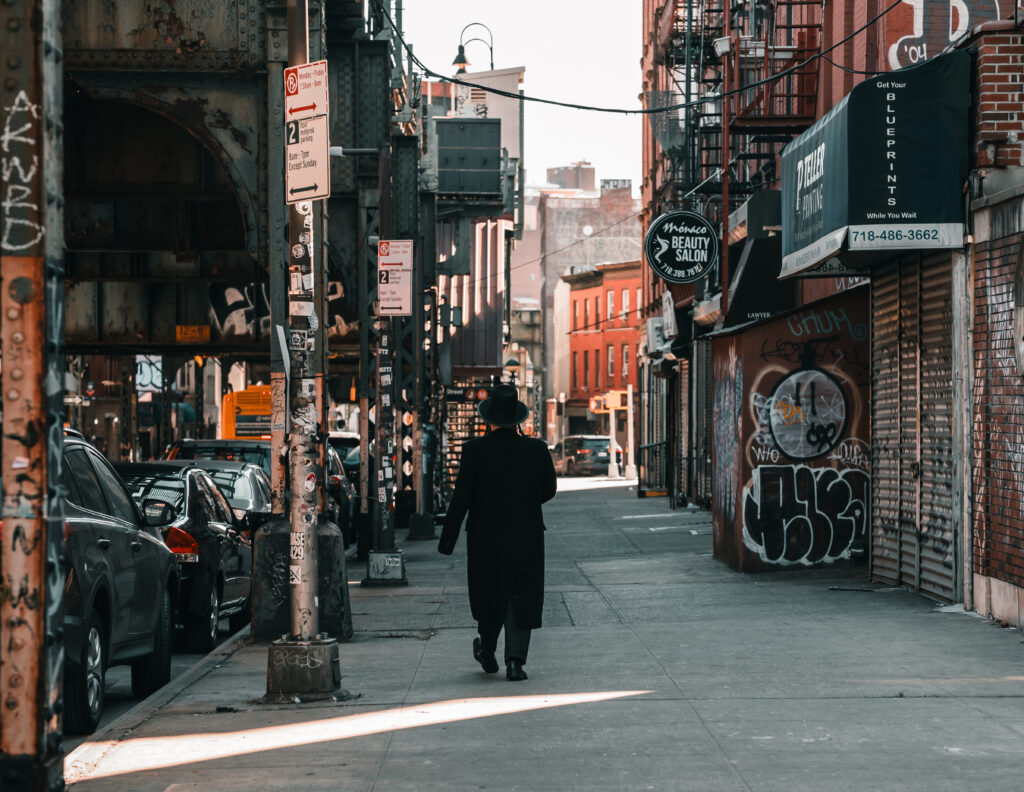
Synagogues surrounded by demonstrators. Campuses where hostility has become normalized. Streets marked by vandalism and assault. A rabbi attacked in Queens. A vehicle driven into a Jewish institution in Crown Heights. These are not isolated incidents. They are part of a pattern.
At the same time, even the definition of antisemitism is no longer settled. In January 2026, New York City revoked its use of the IHRA working definition—the standard used by most U.S. and European governments. What counts as antisemitism is now, officially, contested.
Why this is a civic problem
It is tempting to respond to this moment by turning inward—by focusing on security, lowering our visibility, and waiting for conditions to improve. That instinct is understandable. It is also insufficient.
The policies that shape Jewish life and safety in New York are not made within the Jewish community. They are made in the City Council, the State Legislature, the Mayor’s office, district attorneys’ offices, school systems, and community boards. These institutions respond to those who participate—and overlook those who do not.
In many local elections, fewer than one in five eligible voters cast a ballot. When Jewish New Yorkers are underrepresented in those moments, decisions are made without us. That is not inevitability. It is arithmetic.
What NYSN does
NYSN exists to change that equation.
We build the civic infrastructure that turns concern into coordinated action: registering voters, training members, researching candidates, publishing nonpartisan voter guidance, convening community, and building networks that can respond in real time.
There is no quick fix. But there is a meaningful difference between a community that navigates a hostile moment alone, and one that does so together—organized, informed, and impossible to ignore.